How to Get Rid of Carpet Beetles: A Complete Guide
Key Takeaways
- The larvae cause the damage, not the adult beetles. Look for hairy, carrot-shaped larvae, shed skins, and irregular holes in wool, silk, fur, and leather.
- Start with cleaning, not chemicals: vacuum every edge and corner, wash fabrics at 60°C, and steam clean carpets, because heat kills eggs, larvae, and adults.
- A full clear-out takes about 3 weeks, with daily vacuuming for at least 2 weeks after treatment.
- Professional pest control costs about $200 to $600, depending on how bad the infestation is.
- [OWNER EXPERIENCE: add a real tip or photo from a carpet beetle problem you have dealt with, for example where you found the larvae first.]
A carpet beetle is a small, round beetle, 1.5 to 3.5 mm long, whose larvae feed on natural fibres such as wool, silk, fur, feathers, and leather. Learning how to get rid of carpet beetles means finding the larvae, removing their food, and treating where they hide.
Start with the identification test below, not with a spray. If you treat the wrong pest, you will waste time and money, and the damage will go on.
How do I know if I have carpet beetles?
You have carpet beetles if you find irregular holes or bare patches in wool, silk, or fur, plus hairy larvae, shed larval skins, or tiny sand-like pellets near the damage. Adult beetles on windowsills in spring, especially April to June, are another early sign.
Check the dark, quiet places first. Larvae hide along carpet edges, under furniture, inside wardrobes, in drawers, under beds, and behind curtains, so the middle of a room often looks fine while the edges are damaged.
Larvae moult 5 to 16 times as they grow, and each shed skin is a small, bristly, light brown shell. Finding these casings along baseboards is often the first sign, before you see a live larva.
Tell beetles apart from moths by the holes. Moth damage tends to be round and scattered, while carpet beetle damage is irregular, stays in one area, and often grazes only the top fibres, leaving the backing behind.
For identification photos and species details, see the ePestControl guide to carpet beetles.
| Sign | What it looks like | Where to look |
|---|---|---|
| Irregular holes | Ragged holes, surface grazing, bare patches | Carpet edges, under furniture, wool rugs |
| Hairy larvae | Carrot-shaped, 4–13 mm, brown bands, bristly hairs | Wardrobes, drawers, along skirting boards |
| Shed skins | Light brown, bristly shells | Corners, under beds, behind curtains |
| Fecal pellets | Tiny sand-like bits, same colour as the food | Near damaged items, along baseboards |
| Adult beetles | Small, round, 1.5–3.5 mm, patterned or black | Windowsills, attracted to light |
What are carpet beetles and what do they eat?
Carpet beetles are fabric pests whose larvae feed on keratin, the protein in animal-based materials. That includes wool, silk, fur, feathers, leather, and animal hair, plus the lint, hair, and skin flakes that collect in carpets, rugs, and under furniture at home.
Four species cause most damage: the black, varied, common, and furniture carpet beetles. The black carpet beetle is the most common and destructive in the United States.
Adults do not eat fabric. They feed on pollen outdoors and come inside to lay eggs, often near windows and lights. Only the larvae cause damage, and they can feed for 2 to 11 months, and up to 2 to 3 years in cool rooms.
Larvae will also chew through cotton and synthetic fibres to reach the natural fibres underneath, which is why a cotton sheet stored with a wool blanket can show holes.
How to get rid of carpet beetles step by step
Follow these steps in order. Cleaning comes first, because it removes larvae, eggs, and food, and makes any treatment work better.
- Inspect every room. Check carpet edges, baseboards, wardrobes, drawers, upholstery, and stored clothes, and note each damaged area so you can check it again in 3 weeks.
- Declutter the affected areas. Clear the floor, empty the wardrobes and drawers, and move furniture away from the walls, because beetles hide in clutter.
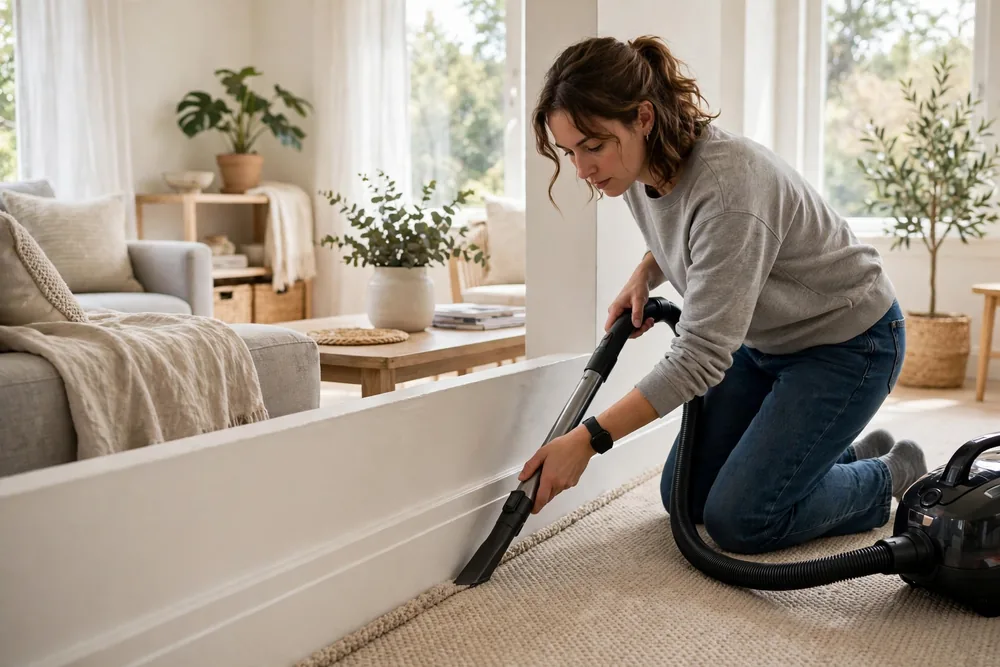
- Vacuum thoroughly. Vacuum every carpet, rug, and upholstered surface, in more than one direction, with the crevice tool along edges and baseboards. Empty the vacuum outside at once, so larvae do not escape back into the house.
- Wash or freeze fabrics. Wash clothing, bedding, and washable fabrics at 60°C, which kills eggs, larvae, and adults. For delicate items, seal them in a bag and freeze them at -18°C for at least 72 hours. Some guides recommend up to 2 weeks.
- Steam clean carpets and upholstery. Heat above 50°C kills all life stages. Steam clean carpets, rugs, and upholstery, paying extra attention to carpet edges and areas under heavy furniture.
- Treat what is left. For a natural option, use food-grade diatomaceous earth, sprinkled lightly, left for about 48 hours, then vacuumed up. For a stronger option, use boric acid, left for 2 to 3 hours, then vacuumed up. Keep children and pets away, and follow the label.
- Repeat and check. Vacuum daily for at least 2 weeks after treatment, to pick up newly hatched larvae before they can feed. Check each damaged area again at 3 weeks, and if you still find live larvae, repeat steps 3 to 6, or call a professional.
Do not skip the repeat step. Eggs can survive the first clean, and the larvae that hatch will start feeding again if you stop vacuuming after a few days.
What kills carpet beetles instantly?
Heat kills carpet beetles at every life stage, including eggs, so steam cleaning and hot washing are the fastest reliable kills. Steam above 50°C and washing at 60°C both work, and temperatures above 120°F, about 49°C, are the level pest guides give for killing all life stages.
No spray kills every egg on contact. The fastest plan is heat first, then a treatment that keeps working, then daily vacuuming for 2 weeks to catch what hatches next.
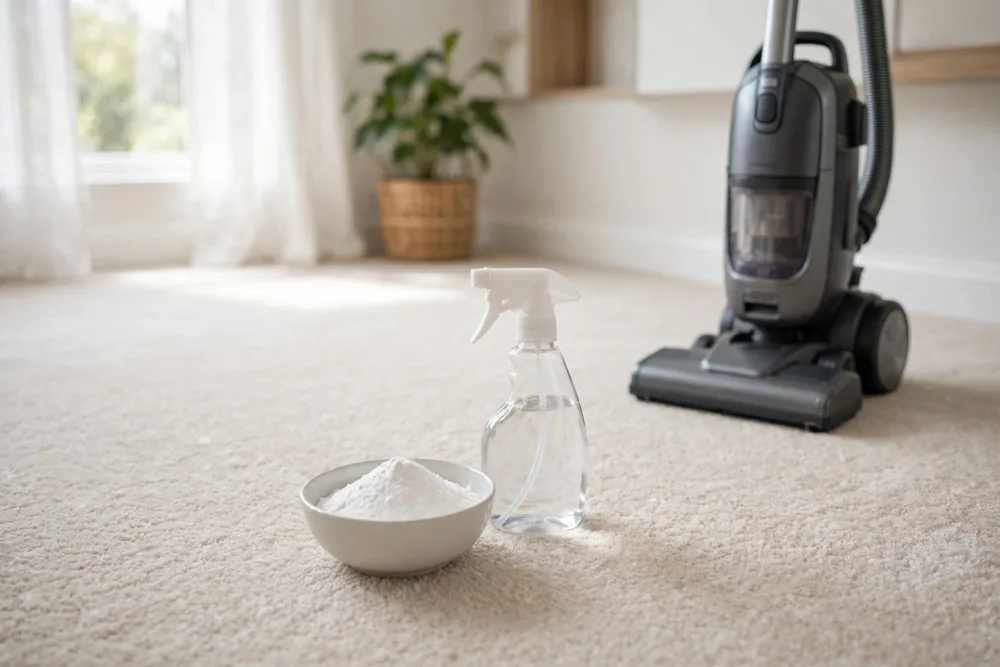
Boric acid kills beetles, larvae, and eggs by drying out their bodies, according to pest experts quoted by Homes & Gardens. Sprinkle it lightly, leave it for 2 to 3 hours, then vacuum it up, and keep children and pets away.
Diatomaceous earth works the same way, by damaging the insect’s outer shell. Use the food-grade variety only, leave it for about 48 hours, then vacuum it up. It is generally safe around children and pets unless eaten in large amounts, according to Angi.
Vinegar does not kill larvae on its own, but it helps as a cleaner and repellent. Mix 1 part vinegar to 3 parts water, spray it on carpets and upholstery, and let it dry. Use it after vacuuming, not instead of it.
Natural vs chemical treatments: which should I use?
Use natural treatments first if you have children, pets, or a small infestation, and use a targeted chemical treatment if cleaning alone has not worked after 2 weeks, or if the infestation is large, keeps spreading, and needs a stronger treatment.
Natural options are slower but safer to use around the home. Chemical options work longer, because a residual spray keeps killing larvae that hatch after you treat, but they need care with children, pets, and food areas. Always read the label.
| Treatment | How it works | Best for | Safety notes |
|---|---|---|---|
| Vacuuming | Removes larvae, eggs, and food | Every infestation, first step | Safe, do it daily for 2 weeks |
| Steam cleaning | Heat kills all life stages | Carpeted rooms, upholstery | Keep hands clear of steam |
| Hot wash 60°C | Heat kills all life stages | Clothing, bedding, washable fabric | Check fabric labels first |
| Freezing -18°C | Cold kills all life stages | Delicate items, small textiles | Seal in a bag, 72 hours to 2 weeks |
| Diatomaceous earth, food-grade | Dries out insects on contact | Natural option, small areas | Do not eat, keep dust low |
| Boric acid | Dries out insects, kills eggs | Stronger natural option | Keep children and pets away |
| Vinegar spray 1:3 | Cleaner and repellent | After vacuuming, light use | Does not kill eggs alone |
| Residual insecticide | Chemical barrier, kills for weeks | Large or recurring infestations | Follow the label, keep pets away |
Chemical insecticides for carpet beetles often contain bifenthrin, deltamethrin, or cyfluthrin, according to Angi. Apply them as a spot treatment to cracks, baseboards, and carpet edges, not as a general spray. Insect growth regulators stop larvae growing into adults, and break the cycle over time.
Do carpet beetles bite?
Carpet beetles do not bite people, and they do not feed on blood. The itchy, welt-like rashes some people get come from touching larval hairs, not from bites. Larvae have stiff, bristly hairs that break off easily and can irritate skin.
If you have a rash and you have found larvae or shed skins, the hairs are the likely cause. Wash the skin with soap and water, wash the bedding and clothing that touched it, and avoid handling larvae with bare hands.
Adult beetles are harmless to people. They are a problem because they lay eggs that hatch into larvae, and those larvae eat your carpets, clothes, and upholstery. That is why treatment targets larvae and eggs, not just the adults you can see.
How long does it take to get rid of carpet beetles?
With the right treatment, you should be able to clear a carpet beetle infestation within 3 weeks or less, according to Angi. That is the time to allow for cleaning, treatment, and daily vacuuming, plus one check at the end to confirm the larvae are gone.
A small infestation in one room can settle faster, in about 1 to 2 weeks. A large one, spread to wardrobes and more than one room, takes longer, because eggs hatch over days and weeks, not all at once.
Vacuum daily for at least 2 weeks after treatment, wash or freeze any new suspect items, and check each damaged area again at 3 weeks. If you find live larvae, repeat the treatment.
Professional pest control costs about $200 to $600, according to Angi. Call a professional if beetles keep coming back after 2 rounds of cleaning and treatment, or if valuable wool rugs, fur, or stored fabrics are at risk.
How do I prevent carpet beetles coming back?
Prevention is mostly cleaning and storage. Larvae feed on lint, hair, and skin flakes, so regular vacuuming removes their food before a population can build. Vacuum carpets at least once a week, and use the crevice tool along edges and baseboards.
Store wool, silk, fur, and other natural fibres in sealed containers or garment bags. Clean clothes before you store them, because food stains and body oils attract larvae.
Seal gaps and cracks around your home, focusing on areas near vents, windows, and utility lines, because adult beetles come in from outside to lay eggs. Keep doors and windows screened in spring, and check second-hand furniture before you bring it inside.
Check stored clothes every few months, especially in spring, for shed skins, holes, and larvae in folds and seams. Catching a problem early means a wash and a vacuum, not a full treatment.

Common mistakes to avoid
The most common mistake is treating only the room where you saw damage. Larvae hide in wardrobes, drawers, and stored clothes, so check every room.
The second mistake is stopping after one clean. Eggs survive the first vacuum and steam, and they hatch over the next 2 weeks, so keep vacuuming daily.
The third mistake is using boric acid or insecticide where children and pets can reach it. Keep them away until you have vacuumed the product up, and follow the label times.
The fourth mistake is throwing away every damaged item at once. Wash or freeze items first, and only throw away fabric that is badly eaten or cannot be cleaned.
The fifth mistake is ignoring the source. If adult beetles keep coming in through a gap near a vent or window, sealing that gap matters as much as treating the carpet.
If you are updating more than one room, see our small living room ideas for the rest of the house, and how carpets and rugs fit into a living room that stays easy to clean.
Frequently asked questions
What kills carpet beetles instantly?
Heat kills carpet beetles at every life stage, including eggs. Steam cleaning above 50°C and washing fabrics at 60°C both work fast. No spray kills every egg on contact, so follow heat with daily vacuuming for 2 weeks to catch what hatches next.
How do I know if I have carpet beetles?
Look for irregular holes or bare patches in wool, silk, or fur, plus hairy larvae, shed larval skins, or tiny sand-like pellets near the damage. Adult beetles on windowsills in spring are another early sign, especially from April to June.
Do carpet beetles bite?
No, carpet beetles do not bite people and they do not feed on blood. Itchy, welt-like rashes come from touching larval hairs, which break off easily and irritate skin. Wash the skin and the bedding that touched it, and avoid handling larvae with bare hands.
How long does it take to get rid of carpet beetles?
With the right treatment, most infestations clear within 3 weeks or less, according to Angi. Vacuum daily for at least 2 weeks after treatment, and check each damaged area again at 3 weeks. If you still find live larvae, repeat the treatment.
Can carpet beetles live in a bed?
Yes, they can live in a bed if the bedding, mattress, or stored clothes nearby contain natural fibres, lint, hair, or skin flakes. Wash bedding at 60°C, vacuum the mattress and bed frame, and check stored clothes in the same room.
What do carpet beetle larvae look like?
Larvae are carrot-shaped, 4 to 13 mm long, with brown bands and stiff, bristly hairs. Varied carpet beetle larvae have bands of light and dark brown, and black carpet beetle larvae have a long tuft of golden-brown hairs at the tail.


