Key Takeaways
- Start with the refinish-or-replace test: if the cabinet box is solid, dry, and the right size, paint it. If it is swollen, delaminating, or the wrong size, replace it.
- A DIY paint remodel costs about $150 to $300 in supplies. A new vanity plus installation runs about $665 to $3,300, with a national average near $1,500.
- Measure first: standard vanity depth is 21 inches, shallow is 18 inches, and you need at least 15 inches from the centre of the toilet to the side of the vanity.
- Keep the plumbing in place if you can. Moving a drain or supply line is the step that turns a weekend job into a plumber’s job.
- [OWNER EXPERIENCE: add a real tip or photo from a vanity you have remodelled, for example the one measurement you wish you had checked first.]
A bathroom vanity is the cabinet, countertop, sink, and faucet that sit together under your bathroom mirror. Learning how to remodel a vanity means learning how to change that one unit well, without tearing out the whole bathroom. This guide covers both routes: paint the vanity you have, or replace it with a new one.
Start with the test in the next section, not with shopping. It takes two minutes and decides your budget, timeline, and shopping list.
Should I refinish or replace my vanity?
Refinish your vanity if the cabinet box is solid, dry, and the right size for the room. Replace it if the box is swollen from water, the surface is peeling away, the drawers no longer close, or the vanity is the wrong width for the wall.
That one test saves more money than any other choice in this project. Refinishing costs roughly 70 to 85 percent less than replacing when the box is sound, according to the 2026 cost guide from LilyAnn Cabinets.
Open every door and drawer. Push on the bottom of the cabinet and look inside for dark stains, soft wood, or a musty smell. Water damage shows up first at the base, around the drain, and under the sink, and paint will not fix soft wood.
Check the size next. If the vanity leaves less than 15 inches from the centre of the toilet to its side, or if the doors hit the toilet when they open, the size is wrong, and only a new vanity in the right width fixes that.
| Your vanity now | Best route | Why |
|---|---|---|
| Solid box, dry, right size, dated colour | Refinish (paint) | Cheapest change, one weekend, no plumbing work |
| Solid box, scratched top, good cabinet | Refinish + new countertop | New top changes the look without moving pipes |
| Swollen base, peeling laminate, soft wood | Replace | Paint will peel and the damage will spread |
| Wrong width, doors hit the toilet | Replace | Only a different size fixes the layout |
| You want a double sink or a new layout | Replace | The cabinet and the plumbing both change |
How much does it cost to remodel a bathroom vanity?
A DIY paint remodel costs about $150 to $300 in supplies for most single vanities, and a new vanity plus installation runs about $665 to $3,300 in total, with a national average near $1,500, according to LilyAnn Cabinets’ 2026 guide. Your final number depends on size, materials, and whether the plumbing moves.
A small 24-inch vanity is closer to $60 to $120 in paint supplies, and a large 72-inch double vanity is closer to $180 to $360. A pre-built vanity itself can cost $200 to $2,000 or more, according to Home Fixology.
Installation alone, for plumbing disconnect and reconnect, setting and levelling, and caulking, runs $200 to $1,000, according to LilyAnn Cabinets. The top end is for jobs where the plumbing rough-in moves.
| Route | Typical cost | Time | Best for |
|---|---|---|---|
| Paint and new hardware | $150–$300 supplies | One weekend | Solid box, dated colour |
| Pro paint job | $400–$1,000 | 2–3 days | Solid box, you do not want to paint |
| New stock vanity + install | $665–$1,500 | 1–2 days | Wrong size or water damage |
| New semi-custom vanity + install | $1,500–$3,300 | 2–5 days | New layout, double sink, stone top |
What size vanity should I buy?
Buy a vanity that fits the wall with room to open doors and drawers, leaves at least 15 inches from the centre of the toilet to its side, and keeps the sink at a comfortable height for most users in the home.
Measure three times: the wall, the vanity, and the path people take past it. Write the numbers down before you order, because a vanity that is 3 inches too wide will not fit, and returning one is slow and costly.
Standard depth is 21 inches. Small bathrooms may need a shallow-depth unit at 18 inches. That 3-inch difference is often what makes a tight bathroom feel usable again, because it frees walking space in front of the sink.
Height matters too. Older vanities sit near 30 inches high, and most new vanities sit at 32 to 36 inches, countertop included. Taller is easier on your back, but check the mirror height too.
| Bathroom | Vanity width | Depth | Notes |
|---|---|---|---|
| Powder room | 18–24 inches | 18 inches | One sink, shallow depth, keep the door swing clear |
| Small full bath | 24–36 inches | 18–21 inches | One sink, leave 15 inches to the toilet centre |
| Standard full bath | 36–48 inches | 21 inches | One sink, room for drawers and a side cabinet |
| Primary bath, double sink | 60–72 inches | 21 inches | Two sinks need at least 30 inches each |
How to remodel a vanity step by step
Follow these steps in order if you are replacing the vanity. If you are refinishing instead, skip to the paint section below and use steps 1 to 3 for prep.
- Measure and order. Measure width, depth, and height, check the drain and supply positions, and order the vanity, countertop, sink, and faucet together.
- Turn off the water. Shut the hot and cold valves under the sink, turning them clockwise until the flow stops. If they leak, shut off the main supply.
- Disconnect the plumbing. Put a bucket under the P-trap, the curved pipe below the drain. Loosen the nuts, let the water drain out, then disconnect the supply lines with a wrench.
- Remove the old vanity. Score the caulk where the countertop meets the wall, remove the screws that hold the cabinet to the studs, then lift the vanity out.
- Fix the wall. Patch holes, sand smooth, and paint the wall behind the vanity now, while you can reach it. Check the floor for water damage first.
- Dry-fit the new vanity. Slide the cabinet into place without fixing it. Check the drain and supply lines line up, and the doors and drawers open fully.
- Level and secure it. Put a level across the top, side to side and front to back. Add shims until it is level, then screw the back rail into the studs.
- Fit the countertop and sink. Set the countertop on silicone caulk. Fit the sink and faucet first, because it is easier to work on while the top is on the floor.
- Reconnect the plumbing. Refit the P-trap and supply lines, tighten by hand, then a quarter turn with the wrench. Turn the water on slowly and check for drips.
- Seal and finish. Run silicone caulk where the countertop meets the wall and where the sink meets the top. Wipe it smooth, fit the hardware, and leave it to cure.
Work in that order and you will not have to move a heavy vanity twice.
For a second walkthrough of the same steps, see Engineer Fix.
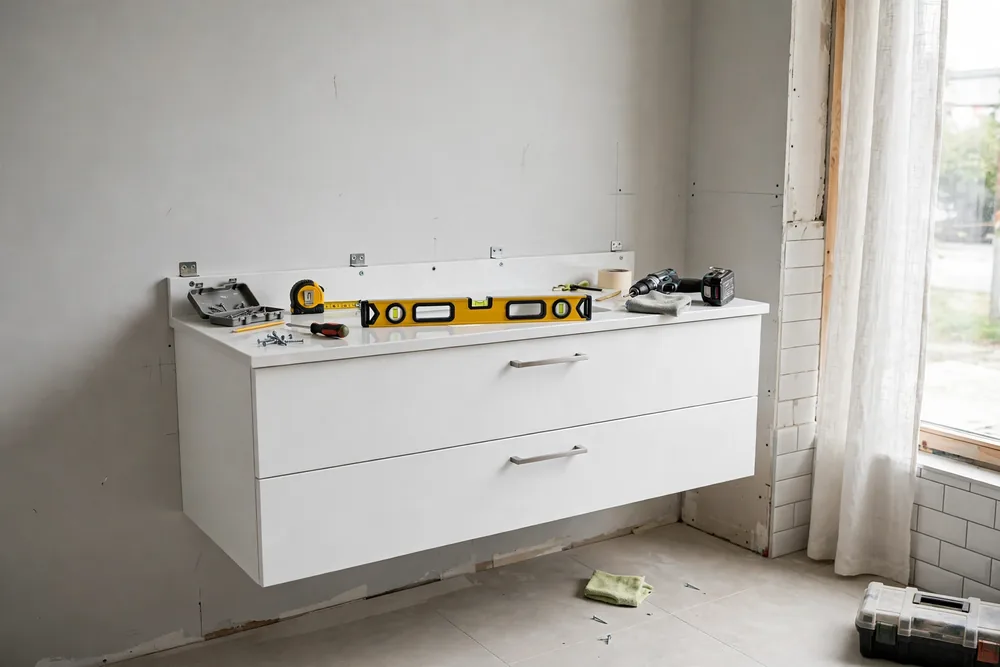
Can I remodel a vanity myself?
You can remodel a vanity yourself if you are only painting it, swapping the hardware, or replacing it without moving the plumbing. You need basic tools, one free weekend, and a second person to help lift the new cabinet into place.
The job stays DIY when the drain, supply lines, and electrical points stay where they are. It stops being DIY when you move a drain, add a second sink, or change the wiring.
Call a licensed plumber if the drain does not line up, if the shut-off valves leak and will not close, or if you need to move a supply line inside the wall. Do not force a pipe that will not move.
A like-for-like vanity swap usually needs no permit. Moving plumbing, adding a sink, or changing electrical work often does, so ask your local building department first.
How do I paint a bathroom vanity?
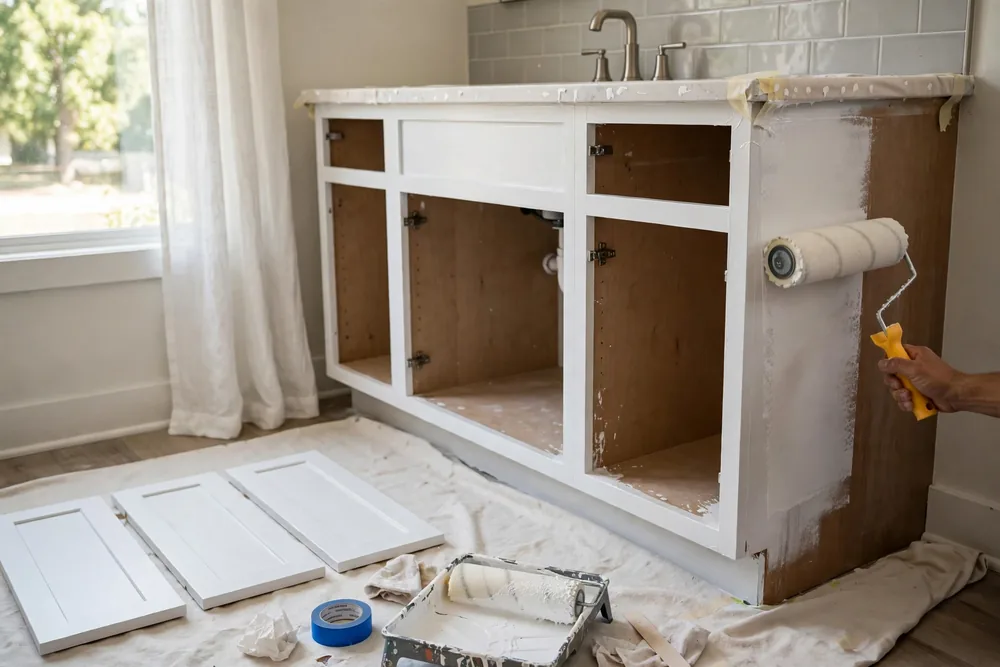
Paint a bathroom vanity by removing the doors and hardware, cleaning and deglossing every surface, priming with a bonding primer, then rolling and brushing two thin coats of cabinet enamel, letting each coat dry fully before you apply the next one.
That is the whole method. The primer is the step people skip and regret, because standard primer peels off laminate, thermofoil, and factory-finished wood. Use a bonding primer on those surfaces.
Label each door with tape so it goes back in the same spot, take the doors somewhere flat, and remove the hardware. Clean every surface with a degreaser, because bathrooms build up hairspray, lotion, and soap film that paint will not stick to.
Scuff-sand real wood with 150-grit, then 220-grit, until the sheen is gone. On laminate or thermofoil, use a liquid deglosser instead of sanding through the wrap, and wipe off all dust before you prime.
Roll the flat areas with a 4-inch foam roller and cut in the profiles with an angled brush. Keep coats thin, because thick coats stay soft and chip. Sand lightly with 320-grit between coats, then add the second coat and let it cure for at least 24 hours before you refit the doors.
For another homeowner’s DIY walkthrough of painting a vanity, see Hunker.
What tools and materials do I need?
The list depends on whether you are painting or replacing, so start with the right set. Buy the paint and hardware first if you are refinishing, and the vanity, countertop, sink, and faucet first if you are replacing the whole unit.
For a paint remodel, gather degreaser, 150-grit, 220-grit, and 320-grit sandpaper or a liquid deglosser, painter’s tape, a bonding primer, cabinet-grade enamel, a 4-inch foam roller, an angled brush, and new knobs or pulls if you are changing them.
For a replacement, gather an adjustable wrench, a level, a stud finder, a utility knife, a drill, screws, shims, silicone caulk and a caulk gun, a bucket, and towels. A second person helps with lifting, because a vanity with a stone top is heavy.
Buy the faucet and drain assembly with the vanity if you can. Faucet hole spacing varies, so check the hole count on the countertop before you order.
What should I buy first on a tight budget?
Buy in this order: paint and hardware, faucet, mirror, lighting, then a new countertop. Paint is the cheapest big change, a new faucet changes how the sink feels to use, and a mirror and light change how the whole room looks.
Skip the new vanity until you have done the test in the first section. If the box is sound, paint and hardware give you most of the change for about $150 to $300. If the box is damaged, save for the replacement instead.
Common mistakes to avoid
The most common mistake is ordering before measuring. Measure the wall, the drain position, and the toilet clearance first, then order.
The second mistake is skipping the bonding primer on laminate or thermofoil. Standard primer peels within weeks in a steamy bathroom.
The third mistake is fitting the countertop before the cabinet is level. An unlevel cabinet makes the sink drain slowly and the top rock.
The fourth mistake is forgetting the wall behind the old vanity. Patch and paint it while the space is empty.
The fifth mistake is moving the plumbing to chase a layout you saw online. Moving a drain even a few feet can add $1,000 to $3,000 to the job.
Frequently asked questions
How much does it cost to remodel a bathroom vanity?
A DIY paint remodel costs about $150 to $300 in supplies. A new vanity plus installation runs about $665 to $3,300, with a national average near $1,500, according to LilyAnn Cabinets’ 2026 guide.
Can I remodel a vanity myself?
Yes, if you are painting it, swapping hardware, or replacing it without moving the plumbing. You need basic tools, one weekend, and help lifting the new cabinet. Call a licensed plumber if the drain does not line up, the valves leak, or a supply line needs to move inside the wall.
How long does it take to remodel a vanity?
A paint remodel takes one weekend, plus curing time. A like-for-like replacement takes one to two days. A custom vanity, or a job that moves plumbing, can take up to five working days.
What size vanity should I buy?
For most bathrooms, a width of 24 to 60 inches, a depth of 21 inches, and a countertop height of 32 to 36 inches works well. Leave at least 15 inches from the centre of the toilet to the side of the vanity, and at least 30 inches of clear space in front of it.
Should I refinish or replace my vanity?
Refinish it if the cabinet box is solid, dry, and the right size. Replace it if the box is swollen, delaminating, or the wrong width. Refinishing costs roughly 70 to 85 percent less when the box is sound.
Do I need a plumber to replace a vanity?
Not for a like-for-like swap where the drain and supply lines stay in place. You do need a plumber if the drain does not line up, a valve leaks and will not close, or you are moving a supply line, adding a second sink, or changing the layout.
If you are updating more than the bathroom, see our small living room ideas for the rest of the house.


